
Intro
This blog post will be about my ventures into local politics or, in my mindset, living the values of democracy. The why, the how, the fun, and the not-so-fun. It’s a simple plug.
Firstly, I want to explain why I am writing this post.
My good mate, asked me about my recent standing for election in the Drumchapel and Anniesland by-election as a local councillor with the Green Party.
“How does it all work?”
“How did you get into it?”
It struck me that local politics and politics, in general, are a dark art for most folk and something that many find weird.
It also made me ask more questions, like why people aren’t all signed up as members of political parties, unions, and organisations that should fight for their interests.
Why are so many people not engaged, and why is election turnout so low? It’s an indictment of the show of “democracy”. See the image below from “understandingglasgow” for the data.
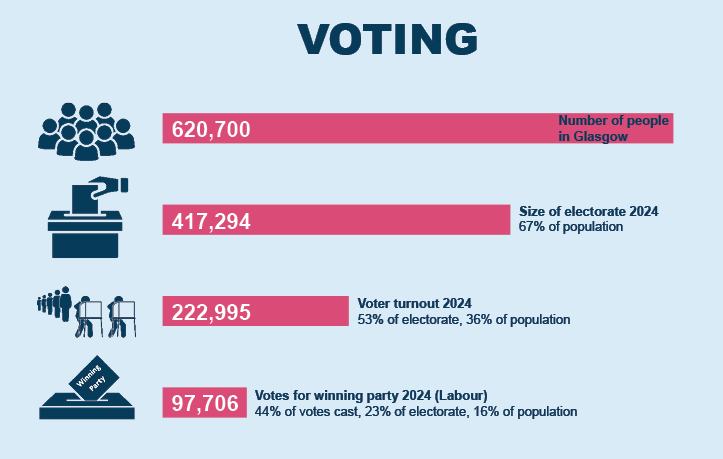
You hear a lot of tub thumping on “British Values” but I’ve yet to hear the free speech and flag lovers belt out about the values of local engagement and local democracy actually say what that looks like and how they will help improve turn-out and voter engagement.
This question and others like this, were why I wrote this post.
Part 1 Why bother – A bit of history
“The desire to be a politician should bar you for life from ever being one.”
“Don’t vote. It just encourages them….”
Billy Connolly is ever the anthropologist. Like many others, I idolise the Big Yin, and this phrase has stuck with me since I read his autobiography and watched him.
He has a point; it is clear as day when you see the Wes Streetings, Farages, Bidens, Trumps, Starmers, Badenocks of the world, weasel and manipulate every word and every sentence, said.
Conscious or unconscious, these characters are just that, characters and to them, politics is a pantomime.
They play to their stalls and their donors, not you and I!
So I hear you ask, why bother joining their ranks? Are you a narcissist and ego-maniac…well. Ha
I’ve always been interested in how people around the world fight for democracy. I took it to heart when I was young and spoke with WW2 veterans in Erskine that I met talk about democracy and standing up for the right to vote, to debate, to deliberate to live side by side with all manner of folk.
This interest was only amplified when I got to visit museums abroad or chatting with locals in countries across Central America and Eastern Europe, I saw how much democracy meant to those who sacrificed so much to have, what many of us take for granted now.
It was clear to me that for many people the world over, the passion for democracy lies in the simple fact of trying to improve their community and the need to be connected and part of a good thing.
A couple of years living in Qatar was a wake-up call. It had a transient population and a local population with abundant wealth, all built on the backs of “imported” Labour and the accident of Geography.
You didn’t have a say; you just put up, shut up, made your money, and went on your way.
On occasion, it struck me how quickly it could all be taken away. The law served to protect certain locals, and you were at their mercy. Threats of deportation, homophobia, and bigotry were acceptable.
Being from my background, I couldn’t afford to go back to sleeping on a fold-down couch in my brother’s room at my mum’s house. So I felt, shut up, put up, and enjoy the silver linings.
That experience made me realise how lucky we are to have a say—and how important it is to use our voice.
This experience made me decide it was time to get involved when I got home. I did not want to be passive about local and regional decisions but to engage, feel like I was part of my community, and support positive change.
Researching for this ramble, I learned this was nothing new.
I learned that Plato had already addressed my feelings. He summed them up nicely in The Story of Ethics with what it meant to have fulfillment.
Plato believed that political engagement was essential, noting that refusing to participate in politics results in being
“governed by inferiors“
Look at today’s politicians. I don’t believe they are “inferior” in the typical sense. Still, they are there to represent a different class of people than the ordinary folk I work, live and have in my life.
I don’t imagine Farage, Badenoch, Starmer, etc, have mates who are pipe fitters, IT geeks, cooks, students, police officers, nurses, train drivers,teachers and occasionally go out for one-to-many and end up in the dancing, thinking I’m too old for this, I have kids to get back to.
Imagine Farage or Badenoch playing in 5 asides and going to the local pub quiz. I can’t.
So that was it. Get in amongst it, don’t shout at the sideline, get in there. But where would I play?
Part 2 – At the most local level – Community Council
When I lived in Bishopton, my first step was to engage with my local community council. I didn’t think it was wise to jump into politics; I wanted to get an idea of things at the first point of entry for local democracy.
So I did take to that, first in Bishopton and then when I moved to Anniesland.
Unsurprisingly, with limited power, resources, and outreach, it doesn’t garner much attention or get people involved.
I wish it did. I want a strategic plan to reimagine democracy in the UK, where everything was devolved to the most local group. Once practicalities had deemed it otherwise, the next level up would take on the responsibility.
So local sports facilities, property tax, amenities, services, cleansing, welfare, and childcare were all devolved to grassroots organisations. This is my dream—grassroots by default.
However, this isn’t the case, so what does a community council do. See the link.
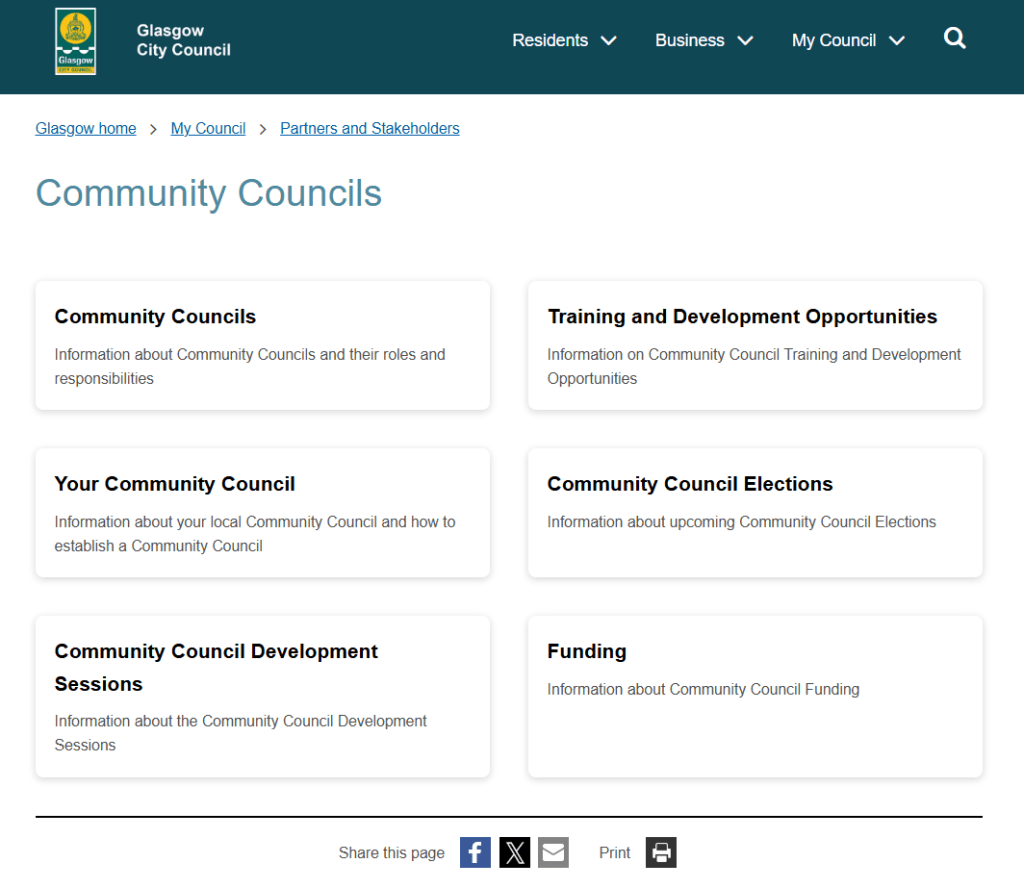
A few things stood out to me in the
Roles & Responsibilities Section
- to be consulted and to make representations about planning applications
- to be recognised as a competent body to comment on licensing applications
- to be representative of all sectors of the community within their area
These, for me, are the only real points of engagement, and this is what turns many folks to feel it’s a talking shop for NIMBY ism and not YIMBY ism.
It is also a challenge for the community councils to engage a range of sectors meaningfully with limited resources and limited rewards – IE, actual engagement other than commenting on planning applications.
This action becomes problematic as it turns off people who realise it can either become a small groupthink in opposition or alienate your neighbours by arguing for development when they all want to keep things as they are—more often the case in wealthier places like my community council.
Anniesland has a housing shortage, and the demand is massive.
Claythorn and others have strongly opposed the conversion of an almost empty office block, a derelict site, and part of a car park into flats.
The key theme in all arguments against these developments is parking and traffic. Motoring over Housing, if you will.
However, most traffic is generated from the suburbs, as most people here have access to buses and trains, and 40% of Glasgow residents don’t have a car.
So, in my five years here, all three sites are still vacant, and house prices continue to tick up, making the area even more unaffordable and the older generation even more protective of their “investment.”
This reflection appears negative, but it is not personal. The people in my community council were very personable, pleasant, engaging, and knowledgeable, with genuine care for the area.
Still, like many opinions, they can be skewed by national headlines and stories, creating division, distrust, and disinformation when it isn’t at the local level—see arguments on active travel all across the UK.
This lack of actual change led me to think, what else can I do?
Part 3 – To the next level – The Cooncil.
This development took a long time coming for me. I took a direct path to support my community. I decided to get involved with a local Social Enterprise, Glasgow Eco Trust, and coach football. These roles are rewarding, but Councillors, MSPs, and MPs were still my go-to for issues, and I got frustrated at some of the replies.
The council is at the sharp end of many if not all, decisions at a national level.
Westminster policy affects energy prices, road projects, public transport, schools, cleansing, parks, leisure facilities, child care, and Housing.
Investment programs, particularly with the trend of the UK government passing Devolved governments with initiatives such as the city deals, also create another layer of complexity.
This results in the public bombarding every Glasgow City Council social media post with hate, bigotry, disinformation, and misinformation on all matters of subjects.
My pet topic is active travel and the avenues project. My usual post is, “A great project that helps the city be more active, sustainable, healthy, and safer.”
The replies contain the usual misinformation bingo card, but they also show the Council leadership being held accountable for things they have no control over—private land, private buses, private energy prices, and private buildings left to rot.
So, this is why I got involved.
I took the step to join the Green Party because their values of People and Planet align with mine.
After being in the party on and off for a few years, helping canvass, leafleting, and getting to know folk, I was encouraged to put my name in the hat for representing my local area in a council by-election.
After vetting, an online discussion, and pitching to local members, I was nominated to become the candidate for the Ward 14 Drumchapel and Anniesland By-election.
Conclusion: Democracy Starts with Us
Getting involved in local politics isn’t glamorous or easy, but it’s essential. It also meant contradicting the Big Yin.
My journey—from joining a community council to standing as a Green Party candidate—has shown me that real change starts at the grassroots level.
Democracy isn’t something we watch from the sidelines. It’s something we do together. Whether we attend a local meeting, join a campaign, or stand for election, we all have a role to play.
I spoke about it on Drumchapel TV when they interviewed me about the local election. See their video.
I appreciated the other candidates who spoke with Drumchapel TV, as it is clear they care about the community.
So, if you’ve ever been frustrated by politics or felt powerless to make a difference, I urge you to take that first step.
- Join a Union – https://www.tuc.org.uk/join-a-union
- Join a Political Party – https://en.wikipedia.org/wiki/List_of_political_parties_in_Scotland
- Get Involved in policy – https://www.parliament.scot/get-involved
- Join a community group
- Get writing and get your elected officials working with and for you! – https://www.writetothem.com/
Democracy only works if we get involved.
If not us, who? If not now, when?
Read More: From Community Councils to Local Elections: A Guide to Getting Started in Politics

 Horizon Glasgow
Leave a comment