
Isn’t it ironic that Antonio Gutierrez and the United Nations declare we are in the “age of global boiling“?
However, under the thumb of Murdoch, UK politics has two “leaders” who say that they don’t like Tree huggers and demand economic expansion depends on oil and gas licensing and that anti-car policies are ruining local economies and supporting motoring .
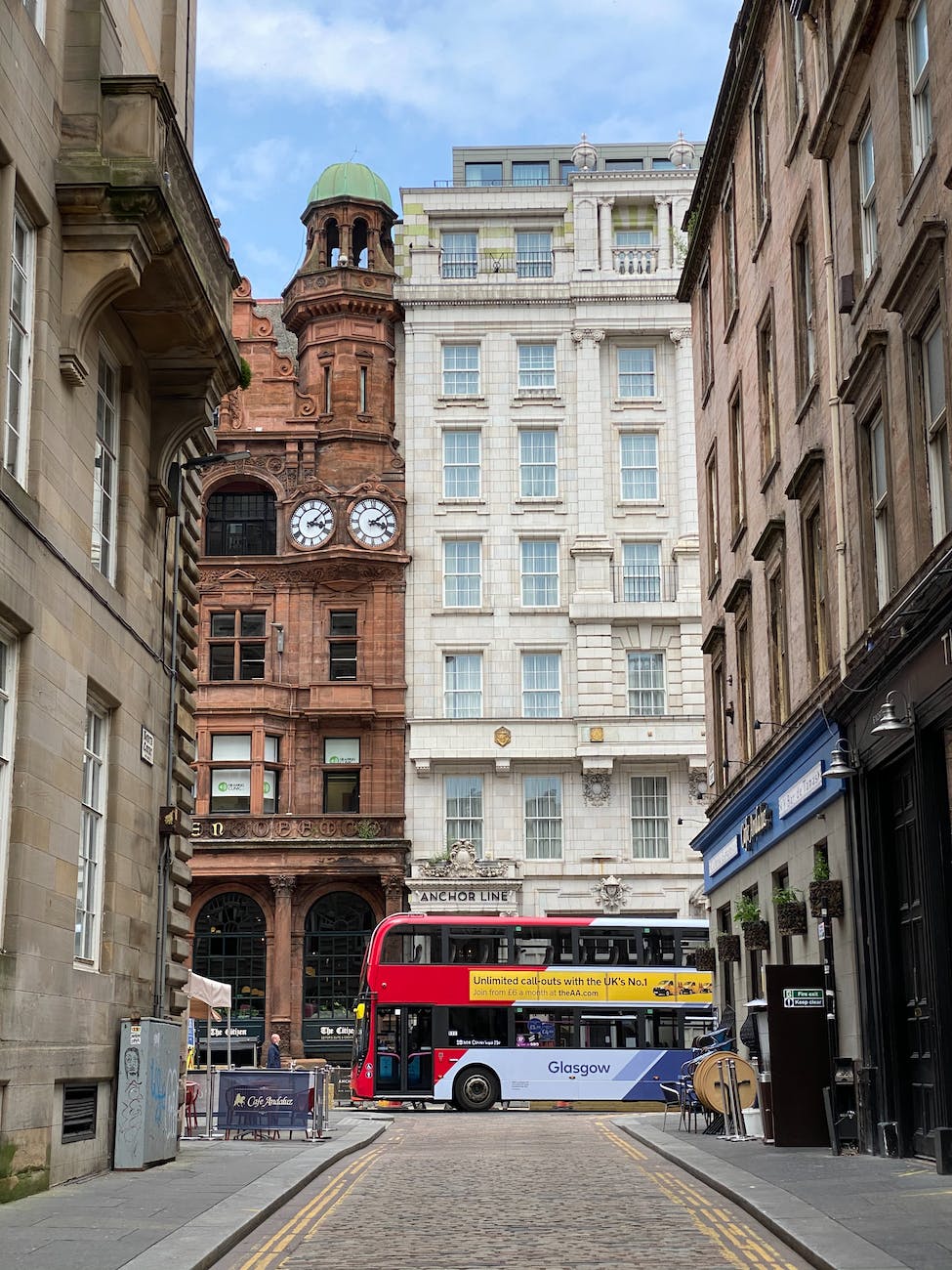
This mixed messaging certainly makes for confusing times on the streets of Glasgow.
Who are we to believe, who are we to trust, and why is there so much contradictory information out there?
It is a minefield.
In this post, I will make the argument. It is not the car that will save Glasgow from its recent economic shocks; it is the people.
Density creates opportunity
People make Glasgow; well, not really. Glasgow has one of the lowest city centre populations in the UK and this makes Glasgow different from other UK Cities. When people talk about Liverpool, Manchester, Leeds, they are talking about Cities with a core city centre with life, Glasgow doesn’t really have that. Compare the cities in Table 1;
See – City Population
| City | Density – people /km² |
| London | 7,490 |
| Birmingham | 5,073 |
| Liverpool | 4,586 |
| Leeds | 4,466/ |
| Manchester | 6,233 |
| Glasgow | 3,619 |
Compare it even further with some of our top holiday destinations. I have chosen these cities as they are comparable in size, except for Paris.
| City | Density – people /km² |
| Paris | 20,321 |
| Lyon | 10,909 |
| Amsterdam | 6,727 |
| Rotterdam | 6,156 |
| Copenhagen | 7,302 |
| Hamburg | 4,035 |
The first shout I hear from the stalls. People drive in Glasgow!
This statement is true; people drive, and therein lies the problem. Sixty years of misdirected planning has turned Glasgow from a Tram-owning, dense, vibrant city to a suburban commuter town.
Much of the discussion now is framed on how we attract motorists. Not people.
If you are a business, community or service, you want people on your doorstep; you don’t want them to spend money getting to you that is cash or time you could be enjoying; you want them to have more money and time in their pocket when they arrive at the door.
Let me explain via, a scalable anecdote; I lived in the village/now suburb, Bishopton in Renfrewshire. I lived in a three-bed corner plot semi, another semi next to us. Our neighbours had one child, our other neighbour’s children had moved out, and then there was an elderly couple. So, you had nine people in the space of a 200-meter walk. That is only nine people going to eat out, using local services, shopping etc.
Contrast that with my now flat in Anniesland though technically in Victoria Park, a ward with an above Glasgow average of 5,891/km² Population Density, despite including the 24 pitches, yes, 24 hectares of land – private and Jordanhill school owned. This density is still considerably greater.
In my building alone, We have three landings of 4 flats. On my landing, there are seven adults, so applying that to each floor, we have 21 people. So, in a 26-meter area, we have 21 folks. On the ground floor, we have a baker and an alterations shop. Next to them are a chiropodist and a barber. Judging by my Monzo account, my wife and I spent 5 figure sums at the bakery downstairs. Our friends, family etc., have also spent a significant amount.
In Bishopton, these businesses wouldn’t survive. They wouldn’t have the opportunity to draw upon new customers or pull in talent to work there.
I’m not the first to explore this; Urban Three have done the math and provided the evidence – it is an American context, but their collected proof is undeniable. Cities are the engines for regions, not the other way around. They are the hubs that provide the ecosystem for people to connect, share and prosper.
If you are a business or a service, where would you want to set up to get the maximum bang for your buck? Suppose you know that, per sq. meter, you will get more customers, and more spending and your customers have more opportunities to share your business. In that case, you know that the possibilities are in Anniesland, not Bishopton.
Lack of density drives up costs
Another frustrating part of the dialogue around Glasgow is the levels of dirt, grime, and general state of disrepair of the city, and many people from all political persuasions can lament this. Now we can argue over the level of grime and pollution. But that doesn’t address the fundamental point. We all want a city to be proud of.
Who is to blame? If you look at LinkedIn , Twitter, and Facebook, you’d think it was squarely at the SNP and Green party.
Who do I blame? Well, I blame the suburbanites. That isn’t true;
Who do I actually blame? I blame the planners and ideology around car culture.
Let me explain myself. Spend per sq. increases with the car.
The car costs us all. Even if we drive, or we don’t drive.
40% of people in Glasgow don’t drive. However, we all spend on cars – infrastructure, repair, maintenance, new build, technology implementation (EV), air pollution, noise pollution, light pollution, contributions to climate change, and road safety issues – (1,500 deaths per year on our roads), event management and this is the direct costs that can be calculated.
We don’t even model the costs of opportunities missed – the number of times people have said they won’t go, there is nowhere to park, or traffic is mental, or it stresses them out, they’re not going to drive to the city.
So, for every meter of road and every car on the road, there is an associated direct and indirect cost across Social, Economic and Environmental factors.
Collectively we have ignored all the actual costs of building infrastructure to support motoring.
To revisit the suburbs, the natural home of the car and low-density living.
Via my old Bishopton mailman, he had to walk up four driveways, each long enough for two cars, and put in 4 doors.
Or the Internet provider had to dig four trenches to run four cables.
Or Scottish Water, they had to dig extra service pipes, waste pipes.
Or the Bin truck driving slowly from house to house
Or the additional Gas pipes
We all had four separate lawnmowers…. you get the drift.
In a denser better-planned building, none of those additional costs exists. There is one water pipe, one waste pipe, one internet cable in, one entry point for the bins and even better, sometimes the mail main has a collective post box area.
I started this chapter; how do we deal with grime? Well, the city needs the resources, and with the cost burden of growing car-dependent infrastructure, no wonder we don’t have the money to fund the parts of the town we see when we walk. We increased our housing, infrastructure, transport, and Service Costs to support suburban sprawl and spread the tax base thinner and thinner. This has meant the city subsidises the suburbs and the city suffers for it.
Density Increases ROI
When I worked for Jacobs Engineering, I started learning the practicalities of Return on Investment (ROI) and revenue gains and revenue drains. ROI is also at the core of urban development and sustainability. When we speak of ROI in the context of cities, it’s not just about financial returns but also about the social and environmental dividends that a community reaps.
When planned and executed well, density amplifies a city’s ROI. Think of my baker—a small space optimizing the site and situation for maximum utility and benefit.
Consider the various points I have made so far, infrastructure costs saved when buildings are closer together, sharing walls, utilities, and services.
The reduced need for extensive infrastructure, the efficiency of transport systems (walking, wheeling, mass transit) in densely populated adds to the vibrancy of local businesses and contribute to a higher ROI for old and new business opportunities.
Moreover, dense areas tend to foster innovation hubs, cultural centres, and social venues, attracting talent, tourism, and investment. The intangible benefits, such as a sense of community, increased social interactions, and cultural exchange, further enhance the ROI.
So, let’s think locally. Think of the Merchant City of Glasgow or the West End; you get the subway or train, have a meal, a movie, and visit a museum.
Suppose you live there, even better.
Since I have moved to Anniesland, I can walk, cycle, and run to work. The ecosystem of services is excellent; I can go from place to place quickly, meet friends, participate in more events, and engage in the community more all without having to spend money on a car – which I have since sold since moving here.
So inherently, you know, if you want to run with an idea, you want to be part of that ecosystem in Glasgow, grow a network of people and share those resources, you know, if you want to do well. You are more likely to do better in one of these areas.
This model of development is reflected globally and historically; cities have shown that well-managed density can lead to exponential growth. For instance, despite their compactness, places like Manhattan in New York or Shibuya in Tokyo generate immense economic output. Their density has made them hubs for finance, technology, culture, and more.
Indulgent of me to mention those two cities, I was lucky to visit, and I wish. For Glasgow, embracing density means economic prosperity and a more prosperous, more vibrant community life. It’s an opportunity to create spaces where businesses thrive, culture flourishes, and people connect. As we envision the future of Glasgow, let’s recognize the potential that density holds in driving unparalleled ROI for our city, both tangibly and intangibly.
Conclusion
I argue that it is not the car that will save Glasgow from its recent economic shocks; it is the people. I challenge you all to think of NYC, Paris, Barcelona, Berlin, and London and to say these places would be better served by knocking down neighbourhoods and building highways and car parks.
These cities aim to enhance their strengths and establish innovation, art, culture, music, and business hubs.
Glasgow needs to grow its density; if Glasgow grew that by a factor of 3 or 4. How much more choice, opportunity, and life will the city have?
Transport and infrastructure will be made more viable, ideas are shared, technology develops and productivity increases.
I hope that the building of this new era for Glasgow can kick-start a virtuous cycle for Glasgow that will make it the place people want to come to work, live and play in.






Leave a comment